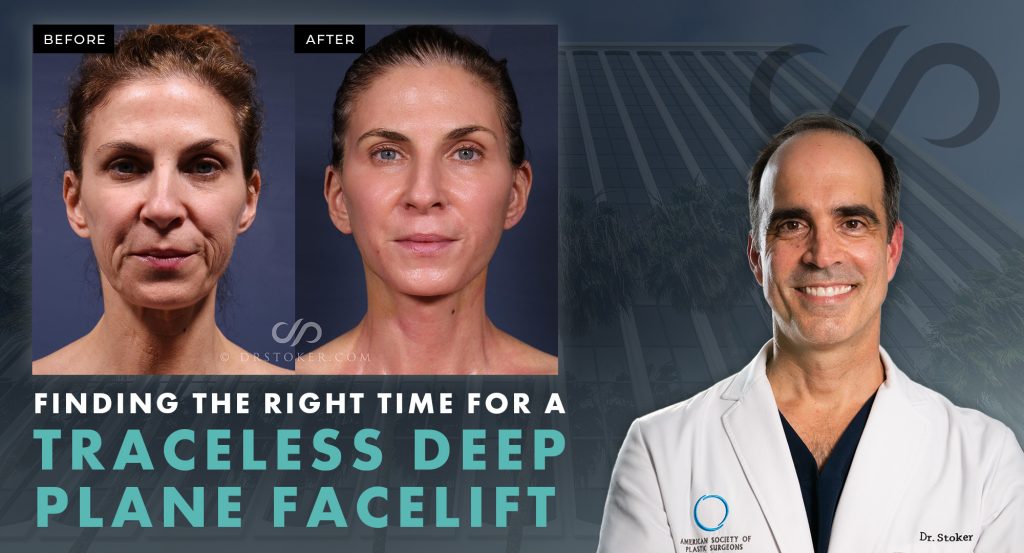
While it’s tempting to think of age as the most important factor, the reality is that the best time for a traceless deep plane facelift depends more on how your face is aging than your actual age.
In my practice, I’ve helped thousands of patients find their “sweet spot” for a facelift, and I’m here to share what I’ve learned over the years. Let’s explore the factors that help determine when it’s time for a traceless deep plane facelift and why there’s no single perfect age.
Why the “Best Age” Isn’t Any One Number
While many people think there’s a magical age when facelifts are most effective, the truth is that age is just one part of the equation. What matters more is how your skin is aging, the degree of sagging or laxity in the face, and your overall aesthetic goals.
For some, starting earlier with a more subtle lift can actually help them maintain a youthful appearance for longer. In contrast, those with more pronounced aging may choose to address more noticeable sagging with a full facelift.
In general, I find that a traceless deep plane facelift works best when the aging process has progressed beyond what injectables or non-invasive treatments can manage, particularly when patients start to notice jowls, deep nasolabial folds, or neck laxity.
Candidacy First, Age Second
When selecting candidates for a traceless deep plane facelift, age is secondary to the condition of your skin and its underlying facial tissues. In fact, I look for several factors when determining whether you’re a good candidate for surgery:
- Visible sagging in the cheeks, jawline, or neck that’s not easily corrected with non-surgical treatments.
- Loss of skin elasticity or an overall “tired” look despite your best skincare efforts.
- Good overall health, as this procedure requires anesthesia and a recovery period.
The “Sweet Spot” for a Traceless Deep Plane Facelift
So, what’s the sweet spot for a traceless deep plane facelift? In my experience, most patients find that their late 40s to early 60s is the best time to consider this procedure. Here’s why:
- Late 40s to early 50s: You’re still likely to have good skin elasticity, which helps ensure that your results will look natural and last longer. A traceless deep plane facelift at this stage can give you a subtle, rejuvenated look that doesn’t appear operated on.
- Mid-50s to early 60s: This is when most patients begin to notice more significant jowls and neck sagging. The traceless deep plane facelift is ideal for addressing these concerns, as it can restore definition and firmness in the jawline and neck while maintaining a natural, youthful appearance.
- Mid-60s and beyond: While it’s true that recovery may take a bit longer as we age, many patients in their 60s and even 70s still make excellent candidates for this procedure, especially if they’re in good health. For those looking for dramatic results, combining the traceless deep plane facelift with a neck lift or eyelid surgery can be highly effective.
What Makes a Traceless Deep Plane Facelift Different?
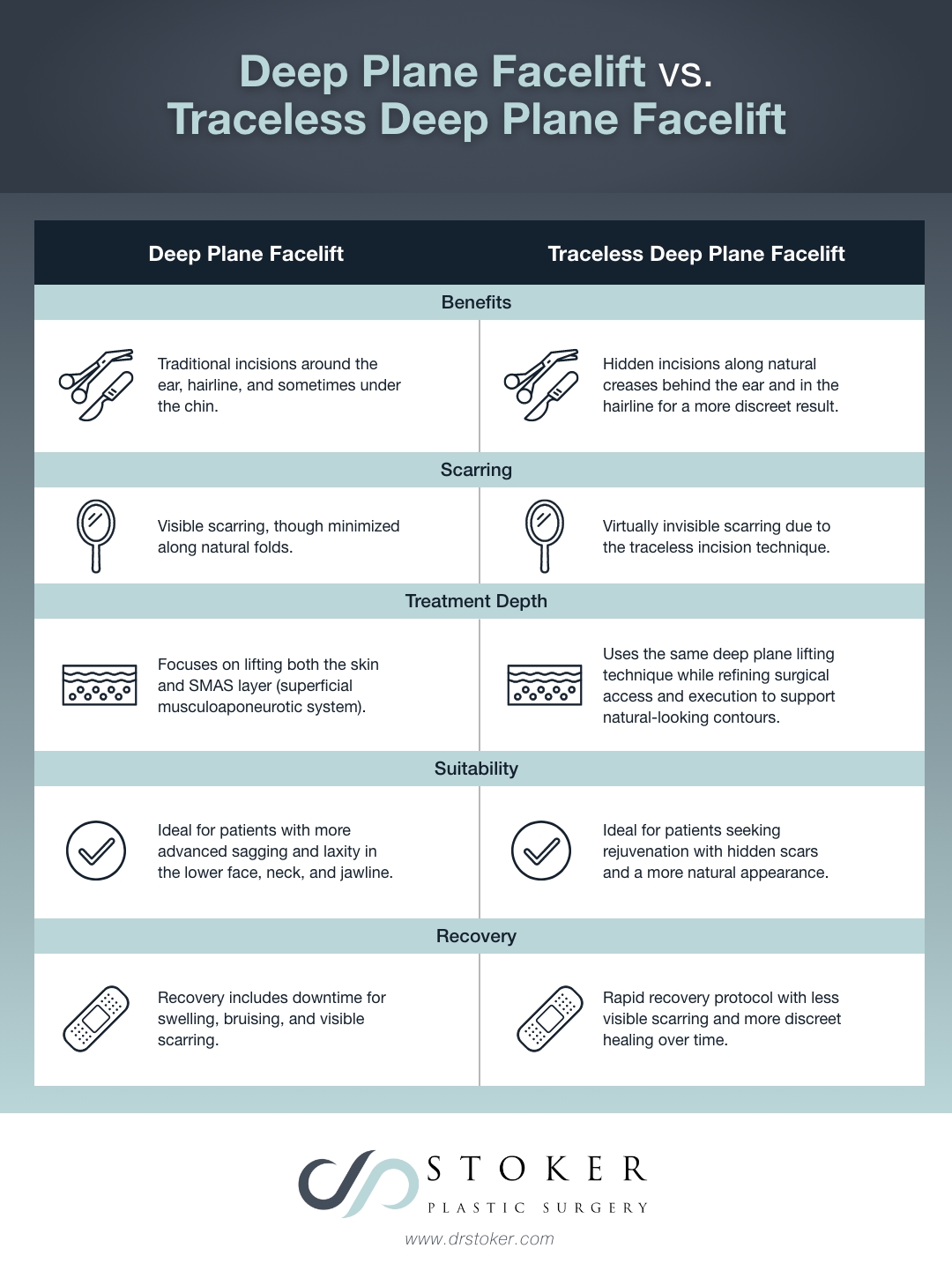
A traceless deep plane facelift is different because it lifts the deeper facial tissues, not just the skin, while placing incisions in discreet, natural creases to minimize visible scarring.
Deep Plane Facelift
A deep plane facelift lifts both the skin and the underlying SMAS (superficial musculoaponeurotic system) as a single unit, allowing me to address deep folds, sagging jowls, and neck laxity by repositioning the facial structures that provide long-term support. This technique provides natural-looking, longer-lasting results without relying solely on skin tightening.
My Traceless Technique
The traceless part of the procedure refers to the hidden incisions that I place along the natural creases of your face, such as behind the ear and in the hairline. This ensures that the scars are virtually imperceptible after healing. Most of my patients are thrilled with how undetectable their scars are, which is one of the reasons I favor this technique.
What sets my approach apart is the combination of advanced deep plane surgery with the traceless incision technique, offering patients both rejuvenation and the confidence of discreet healing.
How a Traceless Deep Plane Facelift Compares to Other Options
| Treatment Type | Best For | Age Range | Longevity | Recovery Time |
| Injectables (BOTOX, Fillers) | Minor wrinkles and volume loss | 30s–50s | 4–6 months | Minimal |
| Mini Facelift | Mild sagging and jowls | 40s–50s | 5–7 years | 1–2 weeks |
| Traceless Deep Plane Facelift | Significant jowling, neck sagging, and deep folds | 40s–70s+ | 10+ years | 2–3 weeks |
Decade-by-Decade Guide: Is It Time Yet?
Here’s a quick guide to help you assess whether it’s the right time for a traceless deep plane facelift based on your age:
Your 40s – Early Warning Signs vs. Early Surgery
In your 40s, you might notice the first signs of sagging along your jawline or the beginning of neck laxity. However, many people in this age group can still achieve great results with injectables, mini facelifts, or skin resurfacing.
Surgery in your 40s may be appropriate if you have a family history of early aging or significant weight loss that’s affected the contour of your face.


Your 50s – The Prime Window for a Traceless Deep Plane Facelift
If you’re in your 50s, you may notice more pronounced jowls, neck bands, or loss of midface volume. This is often the optimal time for a traceless deep plane facelift since it can address the deeper signs of aging with long-lasting results.
Many of my patients at this age are looking to feel confident in their professional and personal lives, making this an excellent time for surgery.


Your 60s and Beyond – Is It Too Late?
Many patients in their 60s and 70s can still benefit from a traceless deep plane facelift if they have realistic expectations, are in good health, and consider the extra recovery time. In some cases, combining a facelift with a neck lift or eyelid surgery can provide the most dramatic results for patients in this age group.


Ready To Get Started?
If you’re considering a traceless deep plane facelift and want to explore whether it’s the right option for you, I’m here to help guide you through the process. Request a consultation online or call Stoker Plastic Surgery at (310) 300-1779 to set up your appointment.
Leave a Reply