
There is a version of body contouring that announces itself — excess tension, unnatural contours, scars that migrate into plain view. And then there is the work Dr. David Stoker has spent more than two decades refining: results that look as though your body simply arrived at its best self. That distinction is not accidental. It is the product of surgical philosophy, technical precision, and a willingness to slow down, plan carefully, and say no when the timing is not right.
The Bikini Body Lift™ was developed with exactly that philosophy at its center. For patients navigating significant lower-body skin laxity — whether after major weight loss, pregnancy, or the dramatic body composition changes that accompany GLP-1 medications like Ozempic and Wegovy — it offers something a standard lower body lift was never designed to deliver: circumferential lower-body contouring with a scar positioned to remain hidden beneath a bikini bottom. The procedure has become one of the most requested surgeries at Stoker Plastic Surgery in Marina del Rey. And with that volume of consultations has come a remarkably consistent set of questions.
What follows is drawn directly from the consult room. These are the questions real patients ask Dr. Stoker before they commit to moving forward — answered here with the same surgical authority and candor they receive in person.
Am I a Candidate? What Dr. Stoker Looks for Before Recommending the Bikini Body Lift
Candidacy for the Bikini Body Lift™ is not a checklist you pass or fail. It is a clinical conversation, and Dr. Stoker approaches it the same way whether a patient has lost 30 pounds or 130.
The first question is always about weight stability.
For patients pursuing skin removal after weight loss — including those whose transformation was accelerated by body contouring after Ozempic or other GLP-1 therapies — the most important prerequisite is a stable weight maintained for a minimum of three to six months. This is not an arbitrary threshold. The tissues that will be resected and repositioned during lower body contouring surgery need to reflect your true baseline. Continued fluctuation, in either direction, changes the tension equations that govern where scars settle, how the skin heals, and how long results endure. Patients who arrive too soon after reaching their goal weight are almost always counseled to wait — and to use that time productively.
The second question concerns the degree and distribution of laxity.
The Bikini Body Lift™ is designed for patients with moderate to significant redundant skin of the lower abdomen, hips, outer thighs, and buttocks. The classic candidate presents with a pannus — a fold or apron of skin below the navel — combined with descent of the lateral thighs and flattening or ptosis of the buttocks. Post-weight-loss body lift candidates frequently describe the sensation of carrying their skin rather than wearing it. That description, while colloquial, is clinically precise: when skin has been stretched beyond its elastic threshold, no amount of exercise or continued weight loss will restore its architecture. Surgical excision is the only intervention that addresses it.
The third question is about overall health and surgical readiness.
Lower body lift surgery — even one as elegantly conceived as the Bikini Body Lift™ — is a major surgical procedure. Dr. Stoker requires that patients be medically optimized before scheduling. Nutritional status matters enormously in post-weight-loss patients, many of whom are deficient in protein, iron, or vitamin D following rapid body-mass changes. Smoking cessation is non-negotiable; nicotine profoundly impairs the microvascular circulation that wound healing depends upon. Patients managing chronic conditions such as diabetes or hypertension are evaluated in collaboration with their primary care or specialist team to ensure those conditions are well-controlled.
A note on body mass index.
There is no single BMI cutoff that determines candidacy universally, and Dr. Stoker is deliberate about this point. A patient with a BMI of 28 who carries the majority of her laxity in the lower body may be an ideal surgical candidate. A patient with a BMI of 32 who has not yet completed her weight-loss journey may be better served by continuing that work first. The evaluation is always individualized — because the goal is always a result that looks proportional, natural, and lasting.
How Is the Bikini Body Lift Different From a Standard Lower Body Lift?
This question comes up in nearly every consultation, and the answer matters. The terms “lower body lift,” “belt lipectomy,” and “circumferential body lift” are often used interchangeably online, which creates real confusion for patients trying to understand what they are actually considering. The Bikini Body Lift™ is a distinct procedure — not simply a marketing name for the same operation.
The defining difference is scar placement.
A traditional lower body lift or belt lipectomy places its primary incision in a horizontal band that typically runs at or above the waistline. The logic is straightforward: that positioning allows the surgeon to lift and resect tissue from the abdomen, flanks, and buttocks in a single pass. The tradeoff is a scar that sits at the natural waistband — visible above most swimwear, activewear, and even many high-rise undergarments.
The Bikini Body Lift™ repositions that incision to follow the precise anatomical contour of a bikini bottom. The scar is designed — from the initial surgical planning stage, not as an afterthought — to remain hidden beneath swimwear. For patients whose motivation for pursuing thigh and buttock lift surgery includes an active lifestyle, time at the beach, or simply the confidence of wearing what they want, this distinction is not cosmetic. It is the entire point.
The technical approach is also different.
Because the incision is placed lower on the body, the vectors of tissue excision and repositioning must be engineered differently than in a standard lower body lift after weight loss. Dr. Stoker uses a customized surgical plan for each patient that accounts for the specific distribution of her laxity, the elasticity of her remaining skin, and the contours she is working toward. The buttocks, in particular, benefit from this approach: rather than simply excising tissue, the Bikini Body Lift™ allows for repositioning that restores volume and projection to a buttock that has deflated and descended — without implants, and without the risks associated with fat transfer into the gluteal vasculature.
The abdomen is addressed in the same setting.
One of the most common follow-up questions at this point in the consultation is whether the Bikini Body Lift™ also addresses the abdomen. The answer is yes — and this is one of its most meaningful advantages over procedures that address only the posterior lower body. The anterior component of the Bikini Body Lift™ incorporates the principles of a formal abdominoplasty, including, when indicated, repair of rectus diastasis (the separation of the abdominal muscles that commonly follows pregnancy or significant weight gain). Patients who have pursued an “Hourglass” Tummy Tuck as a standalone procedure will recognize the philosophy: it is not enough to remove skin. The underlying structure must be restored.
How it compares to isolated thigh lift procedures.
Some patients arrive having already researched thigh and buttock lift surgery as a potential alternative. An isolated medial or lateral thigh lift addresses skin laxity of the inner or outer thighs independently, without the circumferential correction the Bikini Body Lift™ provides. For patients whose concerns are genuinely limited to a single anatomical zone, an isolated procedure may be appropriate. But for the majority of patients presenting after significant weight loss — including body contouring after Ozempic — laxity rarely confines itself to one area. The advantage of the Bikini Body Lift™ is that it treats the lower body as the unified, interconnected structure that it is, correcting laxity of the abdomen, flanks, hips, outer thighs, and buttocks in a single, coordinated surgical plan.
That comprehensiveness is also what makes planning so important — and why Dr. Stoker devotes as much time to the consultation as to any other part of the process.
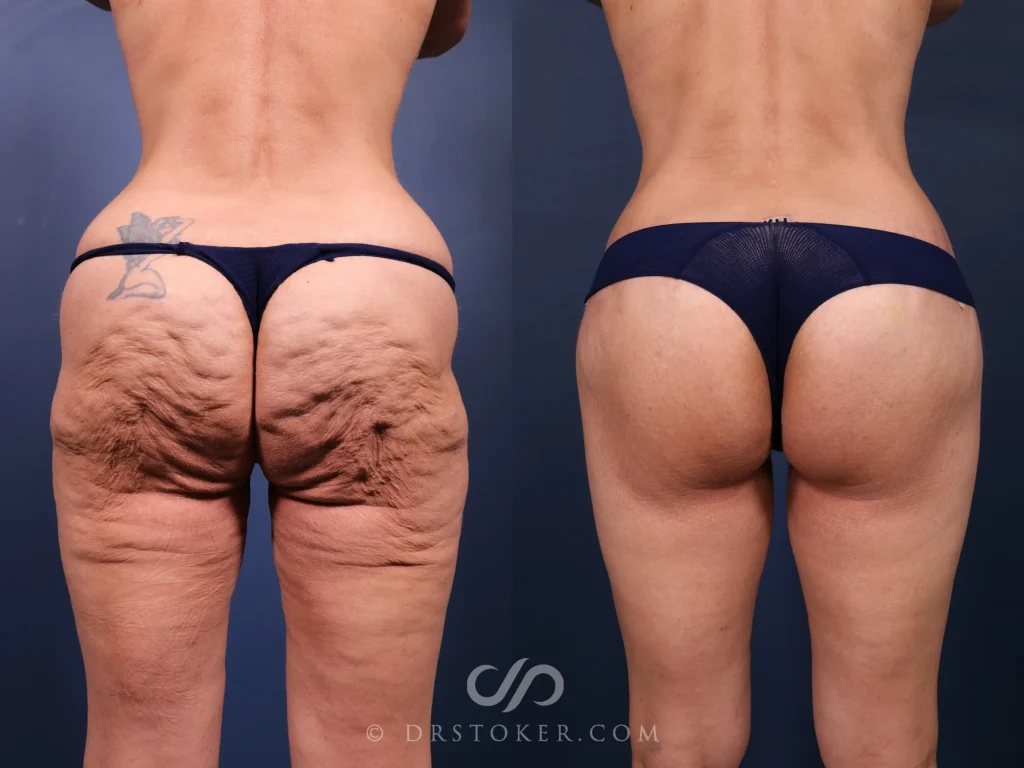
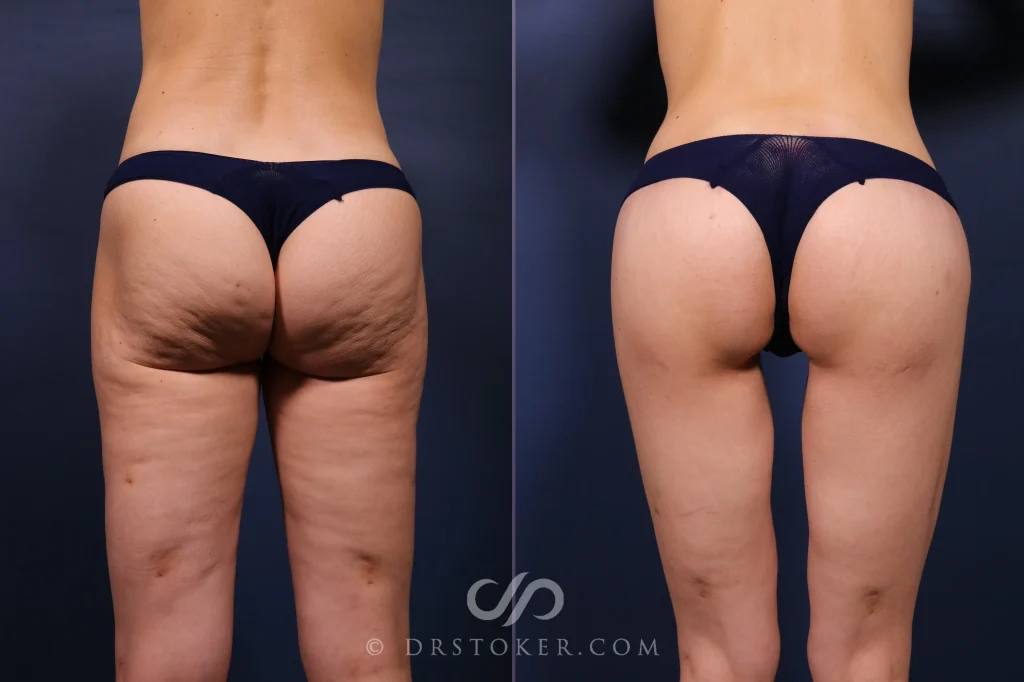
Where Are the Scars, and Will They Show in a Bikini?
This is, without exception, the question that arrives earliest in nearly every Bikini Body Lift™ consultation. It is also the question that most clearly separates a thoughtfully planned operation from a technically adequate one — because scar placement is not an afterthought. It is architecture.
The Logic Behind the Incision Line
The Bikini Body Lift™ is designed around a single governing principle: the incision that makes the procedure possible should also be the incision that disappears most completely. Dr. Stoker plans the excision pattern so that the resulting scar traces the natural upper border of a bikini bottom — low on the hip, angled slightly downward toward the groin, positioned to remain beneath virtually any swimwear cut, including lower-rise styles.
This is not a casual approximation. Before surgery, Dr. Stoker marks the incision line with the patient standing, often asking her to bring in her preferred swimwear or to describe the silhouette she wears most. The goal is a scar that lives permanently within that boundary, so that the final result looks — in a bikini, in lingerie, in everyday clothing — not like the aftermath of surgery, but simply like a body that has been beautifully lifted and transformed.
What makes this possible technically is the degree of planning that precedes it. The amount of tissue to be excised, the tension vectors on closure, the layered repair of deeper fascial structures — each of these decisions influences where the skin ultimately settles. A closure placed under excessive tension migrates. One planned with appropriate tissue release and multi-layer support holds its position. Dr. Stoker’s training and volume of experience — more than 20,000 procedures performed over a career built on precision — meaning the final scar line is mapped before the first incision, not adjusted after the fact.
What the Scar Looks Like Over Time
Immediately after surgery, the incision will appear as a fine line — pink, slightly raised, and, in those early weeks, more visible than the final result will suggest. This is normal. Scars mature. The arc from fresh closure to a pale, flat, softened line typically unfolds over twelve to eighteen months, with the most dramatic fading occurring between months three and nine.
Patients who follow Dr. Stoker’s post-operative scar protocol — which includes silicone sheeting, sun protection, and in some cases adjunct treatments through the Stoker Aesthetics team — consistently achieve results at the better end of that spectrum. Skin type, genetics, and adherence all play a role, and Dr. Stoker discusses realistic individual expectations during consultation rather than offering a universal guarantee. What can be said plainly: in the hands of a surgeon who plans the incision as deliberately as Dr. Stoker does, the scar’s position is as predictable as the result itself.
What Does Recovery Actually Look Like — Week by Week?
The honest answer is that recovery from a Bikini Body Lift™ is significant — and patients who understand that in advance navigate it far more smoothly than those who are surprised by it. Dr. Stoker does not minimize the recovery timeline, because minimizing it would be a disservice. What he offers instead is a clear, realistic map so that patients can plan, prepare, and ultimately move through each phase with confidence.
The First Week: Rest, Support, and Careful Monitoring
The first days following surgery are spent resting, almost entirely. Most patients return home — or to a recommended nearby recovery suite if they have traveled from outside the Los Angeles area — the same day as surgery or after a single overnight observation. Drains are placed to prevent fluid accumulation, and a supportive compression garment is worn continuously. Discomfort during this period is real; it is managed with a structured medication protocol designed to minimize opioid reliance while keeping the patient genuinely comfortable.
Mobility in the first week is limited but deliberate. Short, slow walks — beginning within the first twenty-four to forty-eight hours — are encouraged to support circulation and reduce the risk of complications. These are not rehabilitative walks. They are careful, assisted loops around the room. The body is healing at every layer simultaneously, and the primary job of week one is to allow that process to proceed without interruption.
Swelling is pronounced in this phase, and patients are counseled not to evaluate their results during this window. What they see in the mirror in week one bears little resemblance to what they will see at six months. Understanding this distinction matters enormously for emotional equilibrium during recovery.
Weeks Two and Three: Cautious Progress
By the second week, most patients are meaningfully more comfortable. Drains are typically removed within seven to fourteen days, depending on output, and the absence of drain management brings a notable improvement in day-to-day ease. Light activity around the home becomes more natural. Sitting and reclining remain positions to navigate thoughtfully — some degree of flexion at the hip is often recommended to protect the tension on the incision line during early healing.
Patients who work desk jobs or remote roles sometimes return to limited work in the second or third week, always with the caveat that fatigue will arrive earlier in the day than expected and that screens and meetings should be scheduled accordingly. Physical work, lifting, and anything that raises intra-abdominal pressure remain firmly off the table.
Weeks Four Through Six: Returning to Function
The transition through weeks four to six is, for many patients, the period that most closely matches what they imagined recovery to feel like — progressive, measurable, and genuinely encouraging. Most compression garments are transitioned to a lighter support layer during this phase. Energy levels begin to approximate normal. Walking distance increases with each passing week.
Driving is generally cleared around the four-week mark, contingent on the patient being off all prescription pain medication and capable of reacting quickly. Exercise — particularly any movement that engages the core, the hips, or the lower body with meaningful resistance — remains restricted through six weeks and is reintroduced in stages thereafter. The impulse to accelerate this timeline is understandable and almost universal. Dr. Stoker’s guidance is unambiguous: the tissues healing beneath the surface are not yet ready for the demands that feel manageable from the outside.
Months Two Through Six: The Emergence of Results
This is the phase where patience becomes its own reward. Swelling, which has been quietly resolving throughout the preceding weeks, continues to diminish in a nonlinear, sometimes unpredictable rhythm. The contour of the lower body — the lift of the outer thigh, the smoothness of the flank, the refined silhouette from hip to knee — clarifies progressively. The scar softens. The skin settles.
By month three, most patients are living full, active lives. By month six, the result is largely established, though the final refinement continues through month twelve and, for some patients, beyond. Dr. Stoker’s team remains available throughout this entire arc — post-operative appointments are not pro forma check-ins but substantive clinical assessments of healing progress, with attention to scar management, garment guidance, and any questions that emerge along the way.
Patients who have undergone lower body contouring after significant weight loss — whether through bariatric surgery, GLP-1 medications such as semaglutide, or sustained lifestyle change — often find that the recovery from a Bikini Body Lift™ is less arduous than the weight-loss journey that preceded it. That perspective, offered by patients themselves, is one of the more quietly meaningful things heard in Dr. Stoker’s consultation room.
Will My Results Look Natural, or Can You Tell I Had Surgery?
This is the question that sits underneath almost every other question in the consultation room. Patients rarely ask it so directly — but it is there, embedded in every conversation about incision placement, about profile, about how clothing will fit and how a swimsuit will feel. And it deserves a direct answer.
The short answer is no — not if the surgery is planned and executed with the philosophy that guides every procedure performed under Dr. Stoker’s care. The longer answer is worth understanding, because it explains why.
The Problem With the Overdone Look
Body contouring after significant weight loss carries a particular aesthetic risk that is less discussed than it should be. When skin is removed and tissues are repositioned without careful attention to proportion, the result can look — for lack of a more precise word — corrected. The silhouette reads as altered rather than natural. Contours are too tight in one place, too flat in another. The thigh and buttock lift surgery has done its structural work, but the artistry is absent.
Dr. Stoker’s practice is built on the explicit rejection of that outcome. The same sensibility that defines his approach to facial surgery — the Traceless Facelift philosophy of restoring without revealing — extends without compromise to lower body contouring surgery. Results should look like the best version of a patient’s own anatomy, not like a before-and-after composite.
Proportion, Not Just Removal
A technically proficient Bikini Body Lift™ removes excess skin. A beautifully executed one also sculpts. Dr. Stoker approaches the lower body the way a portraitist approaches a canvas: with an understanding that every decision made in one area affects every other. The height and tension of the buttock lift component must harmonize with the contour of the waist. The inner thigh correction must transition seamlessly into the outer thigh and hip. The pubic region must sit in elegant proportion to the abdomen above it.
This is why the Bikini Body Lift™ is not a single technique but a customized choreography of techniques — adjusted for each patient’s tissue quality, degree of laxity, body proportions, and aesthetic goals. Patients who have undergone body contouring after Ozempic or other GLP-1 medications often present with a particularly nuanced tissue profile: rapid fat reduction that outpaced the skin’s ability to contract, sometimes with varying degrees of laxity across different anatomical zones. Recognizing and responding to that variation — rather than applying a uniform approach — is what separates a result that looks natural from one that simply looks done.
What “Natural-Looking” Means in Practice
Patients sometimes arrive at consultation having seen results elsewhere that gave them pause. The buttocks look lifted but somehow inert. The outer thighs are smooth but the transition to the hip feels abrupt. The lower body looks like it belongs to a different person than the upper body above it.
Natural-looking results, in the Stoker definition, means none of that. It means a silhouette that appears coherent and proportionate from every angle — in clothing, in a swimsuit, in motion. It means thighs and buttocks that have appropriate volume and softness, not just absence of skin excess. It means a result that, five years later, does not betray the procedure that achieved it.
Patients who have traveled from across the country — and, in many cases, from one of the nearly sixty countries represented in Dr. Stoker’s patient base — often cite this philosophy as the reason they chose Marina del Rey over closer alternatives. They were not looking for dramatic. They were looking for right.
How Do I Take the Next Step Toward a Consultation With Dr. Stoker?
For many patients, the decision to pursue a Bikini Body Lift™ has been years in the making. The weight loss journey — whether achieved through bariatric surgery, GLP-1 medications, or the slower, equally demanding work of sustained lifestyle change — was one chapter. Addressing what that journey left behind is another. The consultation is where those two chapters connect.
What to Expect Before You Arrive
The most useful thing a prospective patient can do before their consultation is also the simplest: arrive with honest questions. Not the questions they think they should ask, and not the ones designed to elicit a particular answer. The real ones — about recovery and timing, about how results will look at six months versus two years, about the specific concerns that have been quietly present for a long time.
Dr. Stoker’s consultation style is unhurried and thorough. The goal is not to recommend a procedure; it is to understand a patient’s anatomy, history, and goals well enough to determine whether the Bikini Body Lift™ is the right intervention — and if so, to explain precisely what that would mean for this individual. Patients who are not yet candidates for surgery, because weight loss is still in progress or stabilization has not been sufficient, will hear that clearly and be guided accordingly. Post-weight-loss body lift surgery is only appropriate when the body has reached a stable, sustainable weight — a standard Dr. Stoker holds without exception.
What Dr. Stoker Reviews in the Consultation
A thorough evaluation for lower body contouring surgery considers several factors simultaneously. Skin laxity is assessed across the abdomen, flanks, outer thighs, inner thighs, and buttocks — because these areas do not exist in isolation, and addressing one without understanding its relationship to the others leads to partial results. Medical history, including any prior surgeries, current medications, and overall health status, informs both candidacy and surgical planning. And the patient’s own goals — the specific outcomes that matter to them, the compromises they are or are not willing to make — shape every decision that follows.
This is not a brief intake. It is a substantive conversation, and patients frequently comment that it changed their understanding of what was possible.
The Practice and the Setting
Stoker Plastic Surgery is located in Marina del Rey, California — a setting that reflects the practice’s ethos as much as its geography. The coastal calm, the understated environment, the absence of the transactional energy that characterizes so many aesthetic practices: these are deliberate. Patients traveling from out of town will find a team that understands the particular logistics of coordinating care across distance, including guidance on local accommodations, recovery planning, and post-operative follow-up.
The aesthetic injectors at Stoker Aesthetics — Carla Crespo, MSHS, PA; Brittany Lehmann, PA-C; and Stacy Wright, RN — extend the same philosophy of refinement and restraint to non-surgical care, for patients whose goals are addressed through injectables or those who are supplementing surgical results over time.
Consultations are available by appointment. The invitation is simple: bring your questions. The rest follows from there.
Why Patients Choose Dr. Stoker
There is no shortage of board-certified plastic surgeons in Southern California. Patients who travel from Houston, from New York, from London, from São Paulo — and they do — are not doing so because geography is convenient. They are doing so because they have looked carefully and concluded that something here is different.
A Record Built on Precision
Dr. Stoker graduated first in his class at UCSF School of Medicine and earned the highest national score on the plastic surgery residency examination. These are not incidental details. They speak to the precision of mind that characterizes how he approaches surgical planning — the same rigor applied to a board examination applied to the architecture of a lower body lift.
He has served as an FDA clinical investigator and as a national educator for both The Aesthetic Society and the American Society of Plastic Surgeons, positions that reflect a commitment not just to performing excellent surgery but to advancing the standards by which excellent surgery is defined. When Dr. Stoker teaches other surgeons, he is not transmitting technique alone — he is transmitting a philosophy of what results should look like and why.
Recognition That Reflects Patient Experience
Named among the top surgeons in the country by Newsweek, Castle Connolly, The New York Times, and Los Angeles Magazine, Dr. Stoker holds a 4.73 out of 5 rating across more than 471 patient reviews — a figure that, at that volume, represents not a curated selection but a consistent pattern. The archive of more than 12,000 before-and-after photographs is among the most extensive in aesthetic plastic surgery; it exists because transparency serves patients better than restraint, and because results, viewed honestly and in depth, are the most credible argument a surgeon can offer.
What Patients Say
The words that appear most often in patient accounts of their experience at this practice are not clinical. They describe feeling heard. They describe results that looked like themselves — refined, elevated, but recognizably and authentically themselves. They describe a recovery that, while genuinely demanding in the early weeks, unfolded exactly as they had
Frequently Asked Questions
Is the Bikini Body Lift™ the same as a panniculectomy?
No — and the distinction matters. A panniculectomy is a functional procedure designed to remove an overhanging apron of skin, typically for medical relief. The Bikini Body Lift™ is an aesthetic body contouring surgery: it addresses excess skin and soft tissue of the lower trunk, outer thighs, and buttocks simultaneously, while carefully repositioning and sculpting the underlying tissues to restore natural contour, lift, and proportion. Dr. Stoker approaches the procedure as an artist would a composition — every incision, every tension vector, every sutured layer is placed with the final silhouette in mind.
What is a “360 tummy tuck” or “circumferential tummy tuck,” and how is that different from the Bikini Body Lift™?
“360 tummy tuck” and “circumferential tummy tuck” are terms patients use for an abdominoplasty extended around the entire torso — addressing the flanks and back in addition to the front of the abdomen — rather than a distinct named procedure Dr. Stoker performs. The Bikini Body Lift™ is his refined approach to that same circumferential concept: it treats the abdomen, hips, flanks, outer thighs, and buttocks in one coordinated surgical plan, with the incision specifically engineered to disappear beneath swimwear rather than sit at the natural waistband the way a traditional circumferential procedure’s scar typically does. If “360 tummy tuck” or “circumferential tummy tuck” is the term that brought you here, the Bikini Body Lift™ is worth asking about directly at consultation.
I lost weight on Ozempic (semaglutide). Am I ready for surgery?
Body contouring after Ozempic — or any medically supervised weight-loss program — requires that your weight be stable, not simply reduced. Dr. Stoker asks that patients have maintained their goal weight for a minimum of three to six months before scheduling surgery. This stability matters for two reasons: it ensures the tissues you present on the operating table are the tissues that will define your long-term result, and it significantly reduces surgical risk. Continued weight fluctuation after a lower body lift can compromise skin tension, alter contour, and affect healing. The consultation process includes a candid conversation about your weight history, current medications, and whether this is the right moment — not merely the right motivation — to proceed.
How many procedures can realistically be combined in a single operation?
Safety governs that answer above all else. Dr. Stoker adheres to strict guidelines regarding total operative time and the physiologic demands of combined procedures. In many cases, the Bikini Body Lift™ is performed alongside an abdominoplasty — particularly the “Hourglass” Tummy Tuck — when the anatomy warrants it and patient health supports the duration. Thigh and buttock lift surgery may also be incorporated where indicated. What he will not do is compress an unsafe number of procedures into a single session to accommodate a patient’s timeline. The goal is a result that is both beautiful and durable — and that begins with a surgery performed under conditions that allow him to do his most precise work.
What is the difference between an inner thigh lift and the outer thigh lift that is part of this procedure?
The Bikini Body Lift™ addresses the outer thigh and buttock envelope — the lateral and posterior lower body — through a scar that sits within the bikini line. An inner thigh lift, by contrast, targets laxity and excess skin along the medial (inner) thigh, typically through a separate incision placed in the groin crease or extended vertically along the inner thigh depending on the degree of redundancy. These are anatomically distinct procedures addressing different planes of tissue. Some patients pursuing comprehensive lower body contouring surgery benefit from both; others require only one. That determination is made at consultation, through physical examination and a direct discussion of your specific goals — not through a menu.
How long until I can return to exercise and see my final result?
Light walking begins almost immediately — circulation and early mobility are encouraged from day one. Most patients return to desk work and gentle daily activity within two to three weeks. More strenuous exercise, including core work, resistance training, and anything that places tension across the lower trunk, is typically resumed gradually between weeks six and twelve, guided by your individual healing progress. As for the final result: the shape you see at three months is close, but the tissues continue to refine and settle for up to twelve months. Residual swelling disperses, scars soften and fade, and the contour you ultimately live in emerges gradually. Patience, in this context, is not simply a virtue — it is part of the process.
There is a particular kind of confidence that comes not from looking different, but from looking like the most resolved version of yourself. For many of Dr. Stoker’s patients, the Bikini Body Lift™ represents the final chapter of a longer story — years of effort, meaningful change, and a body that simply no longer reflects what they have accomplished. The procedure does not rewrite that story. It honors it.
Dr. Stoker has performed this work for more than two decades, refining his technique alongside advances in the field and alongside the evolving needs of patients pursuing skin removal after weight loss, post-weight-loss body lift surgery, and comprehensive lower body contouring. What has not changed is his commitment to results that are natural-looking, timeless, and unmistakably — elegantly — the patient’s own.
If the questions answered here have brought you closer to clarity, the next conversation should be with him directly.
We invite you to schedule a consultation at Stoker Plastic Surgery in Marina del Rey, where Dr. Stoker will evaluate your anatomy, listen to your goals, and offer his honest surgical perspective — without pressure, and without shortcuts.
Each patient is unique and individual results may vary.
Leave a Reply