
Both the SMAS facelift and the deep plane facelift go beyond simply tightening loose skin, and both can produce beautiful, natural-looking results when performed by an experienced surgeon. A SMAS facelift repositions the supportive tissue beneath the skin, while a deep plane facelift releases deeper retaining ligaments to allow more extensive repositioning of facial tissues. The best approach depends on your anatomy, degree of aging, goals, and recovery preferences.
I’ve developed advanced versions of both techniques at my Los Angeles practice. My Traceless Facelift uses an advanced SMAS approach, while my Traceless Deep Plane Facelift provides more extensive structural repositioning for patients with advanced facial aging. I don’t believe every patient needs the most aggressive procedure available. Instead, I select the technique based on your anatomy, degree of aging, goals, and willingness to undergo recovery.
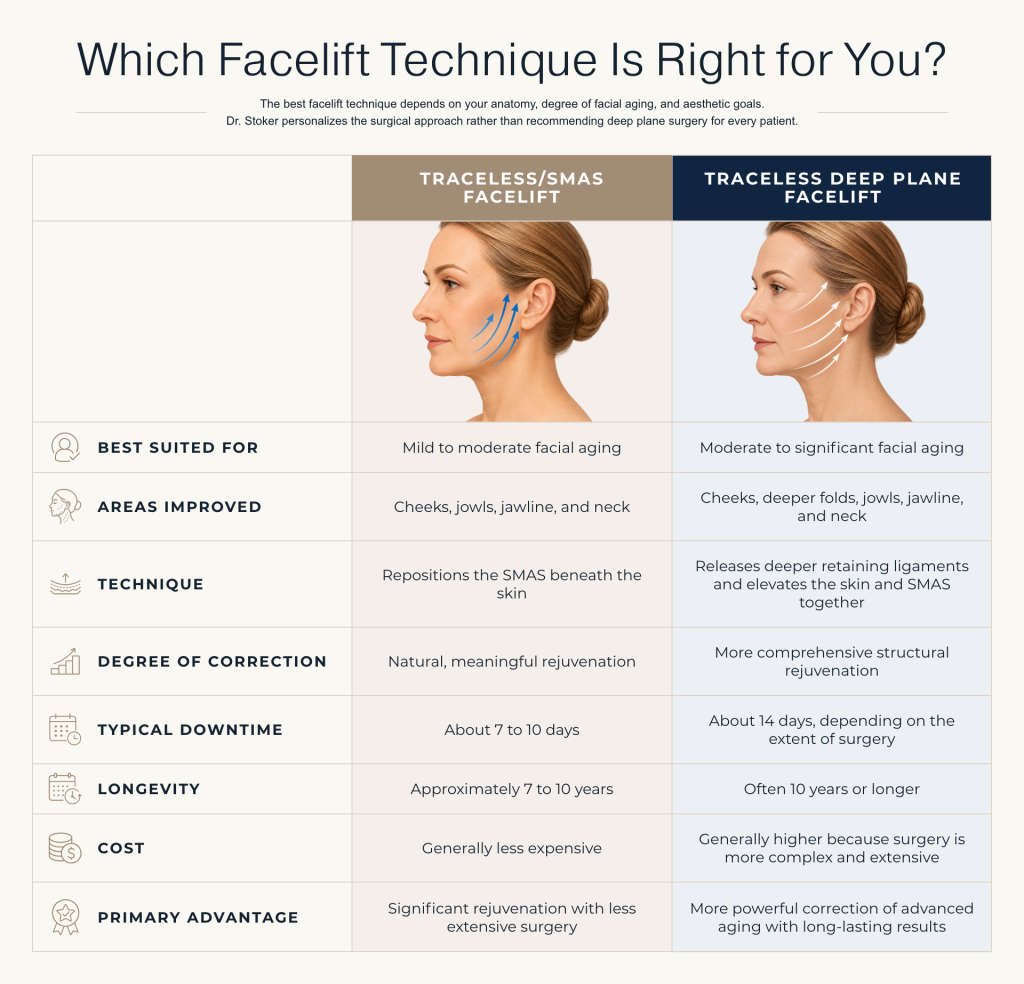
Here’s how these two approaches compare.
What Is a SMAS Facelift?
The SMAS, or superficial musculoaponeurotic system, is the supportive layer of connective tissue beneath the skin. Rather than relying primarily on skin tension, an advanced SMAS facelift repositions this deeper layer to improve facial contours.
My Traceless Facelift is based on this principle. I reposition the SMAS and carefully redrape the skin without excessive tension, helping restore youthful contours through the cheeks, jawline, and neck. I also meticulously conceal the incisions within natural creases around the ears and hairline so the resulting scars are extremely difficult to detect.
For many patients with mild to moderate facial laxity, this approach can provide the degree of correction they want without requiring deep plane surgery.
What Is a Traceless Deep Plane Facelift?
My Traceless Deep Plane Facelift goes a step further than a SMAS facelift. Instead of addressing the skin and SMAS separately, I release key retaining ligaments and elevate the skin and underlying SMAS together as a unit.
Working at this deeper anatomical level allows me to reposition descended facial tissues rather than simply tightening them. I can restore youthful cheek contours, soften deep nasolabial folds, sharpen the jawline, improve significant jowling, and comprehensively rejuvenate the neck.
I’ve refined my Traceless Deep Plane Facelift technique over more than 20 years in practice. I’ve also contributed to deep plane facelift anatomical research and educational courses, and I’ve conducted and presented research on facial nerve anatomy related to deep plane surgery.
The result I’m striving for is significant rejuvenation without an obviously operated appearance.


SMAS vs. Deep Plane Facelift: What’s the Biggest Difference?
The primary distinction between the two techniques is the depth and extent of the surgical dissection.
With my Traceless Facelift, I can reposition the SMAS to correct mild to moderate laxity while limiting the extent of surgery. With the Traceless Deep Plane Facelift, I release deeper ligaments so I can mobilize and reposition the skin and SMAS together.
In practical terms, I generally consider a Traceless Facelift for patients with mild to moderate laxity and volume loss affecting the cheeks, jawline, and neck. My Traceless Deep Plane Facelift is often a better choice for moderate to significant laxity, heavier jowls, deeper folds, and more advanced neck aging.
Neither procedure is inherently “better.” The best technique is the one that provides enough correction for your anatomy without performing more surgery than you need.
Traceless Deep Plane Facelift vs. SMAS Recovery Time
When patients compare Traceless Deep Plane Facelift recovery time with the downtime following a SMAS facelift, the less extensive SMAS procedure generally has an advantage.
My Traceless Facelift typically involves 7 to 10 days of downtime, while Traceless Deep Plane Facelift patients typically need about 14 days off from work for non-strenuous jobs. Deep plane surgery is more extensive, so recovery can vary according to the amount of correction performed and whether I combine the facelift with neck surgery, eyelid surgery, laser resurfacing, or other procedures.
How Long Do the Results Last?
The longevity of results is another difference between the two techniques. I generally expect my Traceless Facelift results to last approximately 7 to 10 years, while Traceless Deep Plane Facelift results can last 10 years or longer.
No facelift stops aging. Your genetics, skin elasticity, sun exposure, weight stability, skincare, and other lifestyle factors will continue to influence your appearance. However, advanced techniques that reposition deeper tissues tend to provide more durable rejuvenation than superficial tightening.
You can read more about the factors that affect how long facelift results last in a previous blog post.
SMAS vs. Traceless Deep Plane Facelift: How Does Cost Compare?
A Traceless Deep Plane Facelift typically costs more than a SMAS facelift because it is more technically complex and extensive than a less invasive procedure.
However, I encourage patients to consider value rather than choosing a surgical technique based solely on price.
If a SMAS Facelift can accomplish your goals, there is no reason to undergo more extensive surgery simply because deep plane facelifts receive considerable attention. Conversely, choosing a less extensive operation solely to reduce the initial cost may not make sense if your degree of facial aging requires a more extensive approach.
Your consultation allows me to evaluate your anatomy and recommend the approach I believe will provide the most appropriate long-term outcome.
Is Traceless Deep Plane Facelift Worth It Compared With a SMAS Facelift?
For the right patient, my Traceless Deep Plane Facelift is definitely worth the cost.
If you have advanced jowling, significant cheek descent, deep facial folds, or considerable neck laxity and want a substantial, long-lasting improvement, the additional surgery and recovery associated with a Traceless Deep Plane Facelift is worthwhile.
If your signs of aging are less advanced, my Traceless Facelift can deliver the natural rejuvenation you want with less extensive surgery.
Age alone, however, isn’t the deciding factor. I frequently recommend a Traceless Deep Plane Facelift for patients in their 50s through 70s, but facial anatomy and degree of aging matter much more than your age. You can read my guide to choosing the best age for a Traceless Deep Plane Facelift for a closer look at timing.
Choosing the Right Facelift for Your Face
I’ve performed thousands of facial rejuvenation procedures, and that experience has reinforced an important principle: facelift surgery should never be one-size-fits-all.
Some patients need the additional structural correction of my Traceless Deep Plane Facelift. Others can achieve outstanding results with my Traceless Facelift, while younger patients with early signs of aging may be better candidates for a Traceless Mini Facelift or nonsurgical treatment.
During your consultation, I’ll carefully evaluate your cheeks, jawline, neck, skin quality, underlying anatomy, and aesthetic goals. From there, we can determine which approach offers the right balance of rejuvenation, longevity, recovery, and value for you.
You can request a consultation using the online form or by calling our Marina del Rey practice at (310) 300-1779.
Leave a Reply