Skin that suddenly feels drier, thinner, or less resilient in a woman’s 40s or 50s is rarely a mystery to the women experiencing it — even when it’s difficult to pin down exactly why. Many patients arrive at Stoker Aesthetics describing the same shift: skincare that used to work no longer does, makeup sits differently, and the face in the mirror seems to have changed faster than expected. For a large number of these patients, the underlying driver is hormonal. Estrogen decline during perimenopause and menopause has a well-documented, direct effect on the skin’s structure — and understanding that connection is the first step toward a treatment plan that actually addresses it.
What Menopause Actually Does to Skin
Estrogen plays a central role in maintaining the skin’s collagen, hydration, thickness and resilience. As estrogen levels decline during the menopause transition, dermal fibroblasts — the cells responsible for producing collagen — become less active, and the skin’s structural framework begins to change. A 2026 review in the Journal of Integrative Dermatology summarizing the current research on menopause-associated skin changes describes collagen loss estimated at up to 30% within the first five years following the onset of menopause, along with decreased skin thickness, disorganized collagen structure, diminished elasticity, and impaired hydration. Changes in ceramide composition and reduced hyaluronic acid production also weaken the skin’s barrier function, which is part of why skin can start to feel drier or more reactive during this transition.
This is not a single-cause phenomenon, and it should not be treated as one. Skin quality and facial appearance in midlife are shaped by a combination of factors — aging, genetics, sun exposure, weight fluctuation, pregnancy history, and skin elasticity all play a role alongside hormonal change. Menopause tends to accelerate and compound shifts that were already underway rather than acting as the sole explanation for every patient’s concerns. Dr. Stoker and the Stoker Aesthetics team evaluate each patient’s skin and facial anatomy individually rather than assuming hormones alone explain what any one patient is seeing in the mirror.
Why This Moment Is Different for Aesthetic Planning
Patient interest in aesthetic treatment does not distribute evenly across a lifetime — it clusters. According to NewBeauty’s Summer 2026 “State of Aesthetics” report, 34.1% of women surveyed identified their 40s as the decade when aesthetic priorities feel most urgent, with another 28.8% pointing to their 50s — together accounting for nearly two-thirds of respondents. Only 7.2% said they preferred to age without any aesthetic intervention at all. The same report found that 70.8% of respondents were interested specifically in skincare formulated for menopausal skin, and that energy-based treatments — lasers and radiofrequency microneedling among them — were the most popular treatment category, drawing interest from 76.6% of respondents. When asked what mattered most in choosing a menopause-related treatment, efficacy ranked first, followed closely by cost and safety — consistent with a patient population the report describes as experienced, informed consumers rather than first-time treatment seekers.
With decades of experience as aesthetic specialists, Carla Crespo, MSHS, PA; Brittany Lehmann, PA-C; and Stacy Wright, RN, are among the most respected aesthetic injectors in the Los Angeles area. Because they see a high volume of patients moving through this exact life stage, they are often the first to help a patient understand which of her concerns are best addressed topically, which respond to energy-based or injectable treatment, and which may ultimately call for a conversation with Dr. Stoker about surgical options.
A Stepped Approach, Not a Single Fix
Rather than defaulting to any one treatment, Stoker Aesthetics approaches menopausal skin change the way most experienced providers do: as a spectrum of options that can be layered or escalated as a patient’s needs evolve.
Topical and skincare-level support
For patients in earlier stages of the transition, or those whose primary concerns are dryness, dullness, or early textural change, topical treatments are often the starting point. Stoker Aesthetics’ topical treatment offerings — including laser genesis skin rejuvenation, IPL photofacials, and professional peels — are designed to support collagen stimulation and even out tone and texture without more involved intervention.
Energy-based and injectable treatments
When skin laxity, deeper textural irregularity, or volume loss become more noticeable, energy-based devices and injectables often come into the conversation. Stoker Aesthetics offers Morpheus8 RF microneedling and Ultherapy for skin tightening, along with Sculptra for gradual, collagen-stimulating volume restoration — treatments that directly address the collagen and elasticity changes associated with declining estrogen. The practice’s injectables lineup, including dermal fillers, BOTOX® and neuromodulators, and stem cell– and exosome-based skin rejuvenation options, is designed to be combined thoughtfully rather than applied as a one-size-fits-all protocol. A recent 2026 clinical review of menopause-associated skin changes identifies exosome-based approaches as a promising, targeted option for patients whose skin-quality concerns don’t fully respond to topical care alone—an area where in-house access to the treatment, rather than a referral elsewhere, matters.
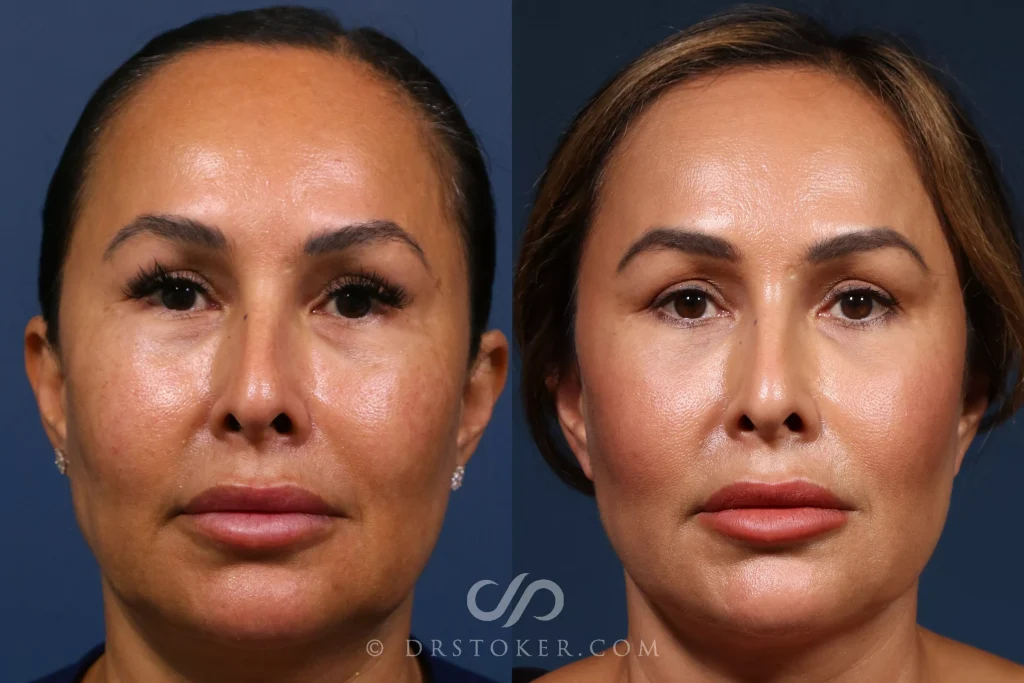
Patients considering this category of treatment are often the same ones asking how to avoid looking overdone rather than refreshed — a concern the practice has written about directly. As explained in Natural-Looking Botox® and Filler Los Angeles: Refreshed vs. Overdone, the difference between a subtle, natural result and an obviously treated one comes down to technique and restraint, not the products themselves — a principle that applies just as much to menopausal skin treatment planning as it does to any other injectable conversation.
When Skin-Quality Treatments Aren’t Enough: Considering Surgical Timing
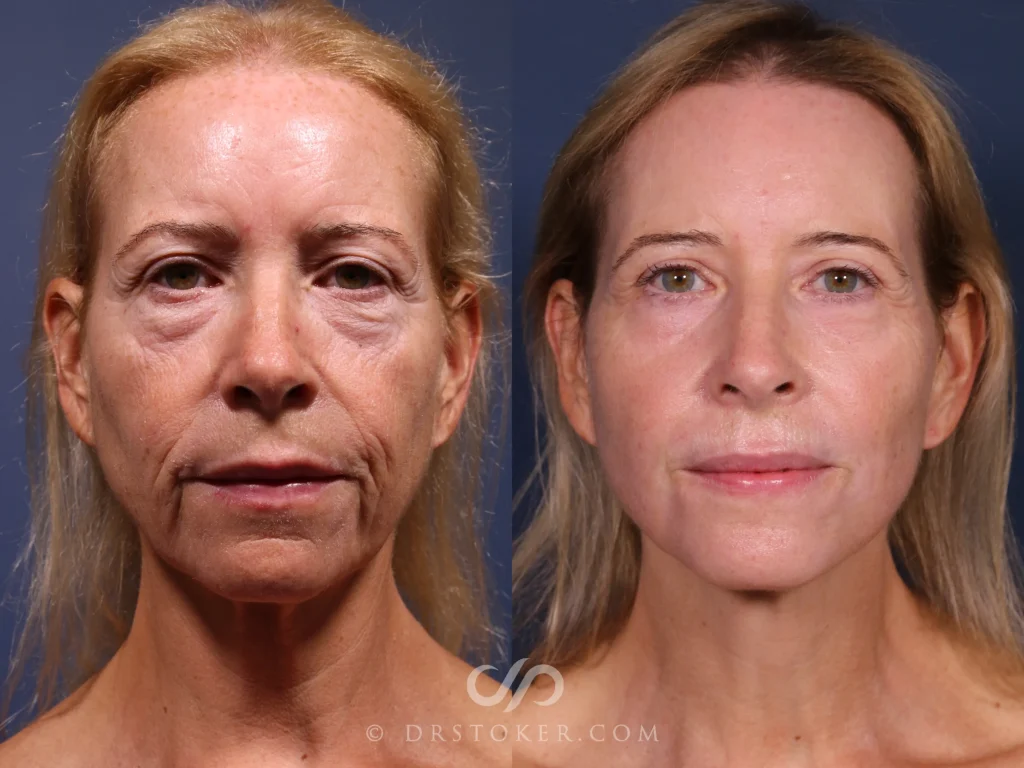
For some patients, hormonal skin change coincides with — or accelerates — structural changes in the face and neck that topical care, energy-based devices, and injectables cannot fully address: significant skin laxity along the jawline, descent of the brow, or deeper folds that have become resistant to nonsurgical treatment. This is where Dr. Stoker’s perspective on surgical timing becomes relevant to the broader treatment-planning conversation.
Dr. Stoker trained at NYU’s Institute of Reconstructive Plastic Surgery, including under Drs. Sherrell Aston and Daniel Baker — surgeons who helped define the modern deep plane facelift approach — and has spent his career refining that foundation into his own Traceless Deep Plane Face & Neck Lift™ technique. For patients whose facial aging has progressed beyond what nonsurgical treatment can reasonably achieve, Dr. Stoker evaluates each patient’s skin quality, bone structure, and degree of laxity individually before recommending a surgical timeline — there is no fixed age, hormonal status, or menopausal stage that determines candidacy. Some patients are appropriate candidates for a Traceless Facelift or brow lift while still managing perimenopausal symptoms; others benefit from building skin quality with nonsurgical treatment first and revisiting surgical options later. The decision is planning-based, not calendar-based.
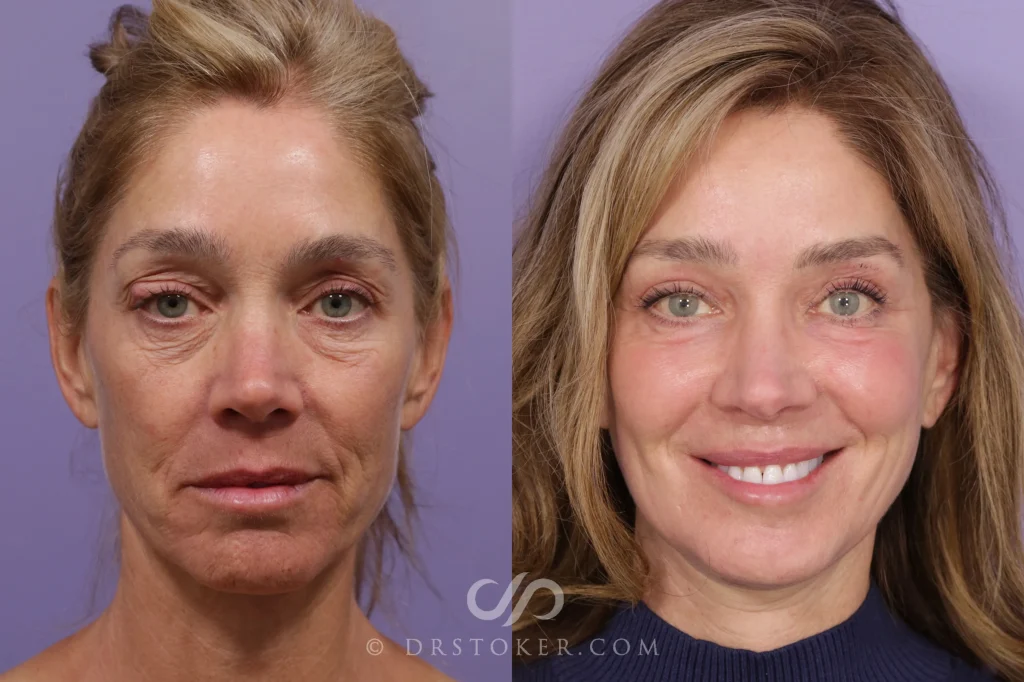
This is also where the practice’s broader philosophy matters: nonsurgical and surgical treatment are not competing options but points on the same continuum. A patient who starts with topical care and energy-based treatment in her 40s may, years later, be a well-prepared surgical candidate — with skin that has been better maintained in the interim than it would have been without any intervention at all.
Frequently Asked Questions
Does menopause cause skin aging, or does it just make normal aging more noticeable?
Both. Estrogen decline directly reduces collagen production and skin hydration, which accelerates changes that would eventually occur with aging alone. But genetics, sun exposure, weight history, and skin elasticity all continue to play a role — menopause is a significant contributing factor, not the sole cause of any individual patient’s skin concerns.
Is hormone replacement therapy (HRT) a substitute for aesthetic treatment?
Research has associated both topical and systemic estrogen therapy with improvements in skin thickness, hydration, and wound healing, and HRT is a legitimate part of some patients’ broader menopause care. However, HRT carries documented systemic considerations that patients should discuss with their prescribing physician, and it is not an aesthetic treatment in itself. Stoker Aesthetics providers and Dr. Stoker do not prescribe or manage HRT, but they routinely work alongside what a patient’s other physicians have recommended when building a skin-quality treatment plan.
What’s the right age to start treating menopausal skin changes?
There isn’t a single right age — perimenopause and its skin effects can begin years before a woman’s final menstrual period, and the pace of change varies widely between patients. Rather than waiting for a specific birthday or menopausal milestone, Dr. Stoker and the Stoker Aesthetics team recommend evaluating skin quality and treatment goals as changes actually appear, so a plan can be built around the individual patient rather than a general timeline.
Can nonsurgical treatments alone address significant skin laxity?
Energy-based treatments like Morpheus8 and Ultherapy, along with Sculptra and other injectables, can meaningfully improve skin tightness, volume, and texture, and many patients find that combination is enough to meet their goals. For patients with more advanced laxity — particularly along the jawline, neck, or brow — nonsurgical treatment has real limits, and a surgical consultation with Dr. Stoker can clarify whether a Traceless Facelift, Traceless Deep Plane Face & Neck Lift™, or brow lift would better address the specific structural change involved.
A Plan Built Around the Patient, Not the Calendar
Menopause is a hormonal transition, not a single aesthetic diagnosis — which is exactly why a one-size-fits-all approach to treatment rarely serves patients well. Whether a patient’s next step is a topical treatment plan with the Stoker Aesthetics team, an energy-based or injectable protocol, or a surgical consultation with Dr. Stoker to discuss facelift or brow lift timing, the starting point is the same: an individualized evaluation of what’s actually happening in that patient’s skin and facial structure, not a generic protocol tied to age or menopausal stage. Patients interested in discussing their own skin changes — whatever stage of the transition they’re in — are encouraged to schedule a consultation with the Stoker Aesthetics team or with Dr. Stoker directly.
Leave a Reply