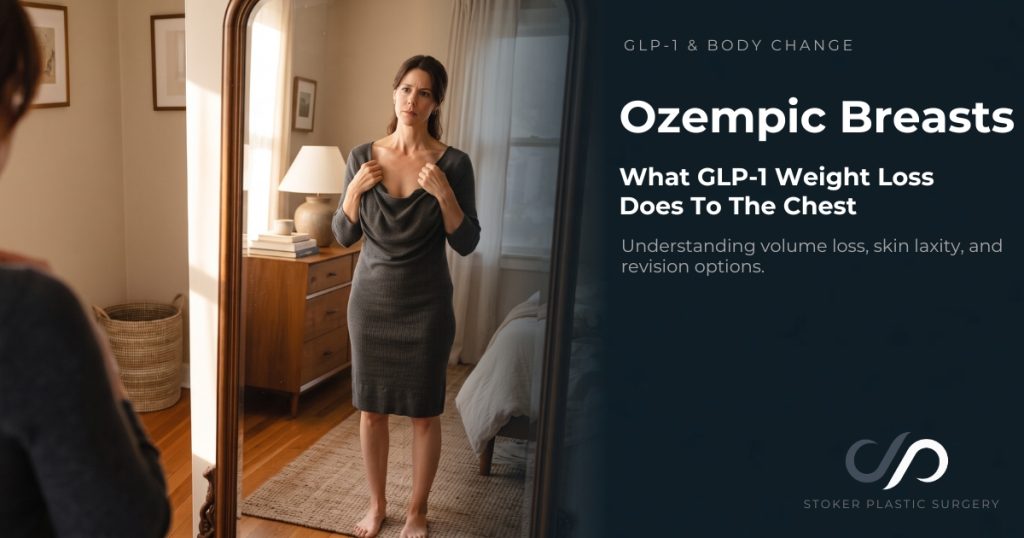
If you’ve lost a significant amount of weight on a GLP-1 medication like Ozempic, Wegovy, Mounjaro, or Zepbound, you may have noticed a change you didn’t expect: your breasts look smaller, flatter, or less lifted than the rest of your new frame would suggest. You’re not imagining it, and you’re not alone. It’s become common enough that it now has a name — “Ozempic breasts” — and it’s one of the most frequent concerns Dr. David Stoker hears from patients in consultation right now.
Dr. Stoker has spent much of his career treating patients whose bodies have changed dramatically after significant weight loss, long before GLP-1 medications existed. What he’s seeing today in GLP-1 patients is a variation on a pattern he already knows well: rapid, substantial fat loss changes the chest differently than it changes other areas, and understanding why is the first step toward deciding what, if anything, a patient wants to do about it.
Why Breasts Change So Noticeably With GLP-1 Weight Loss
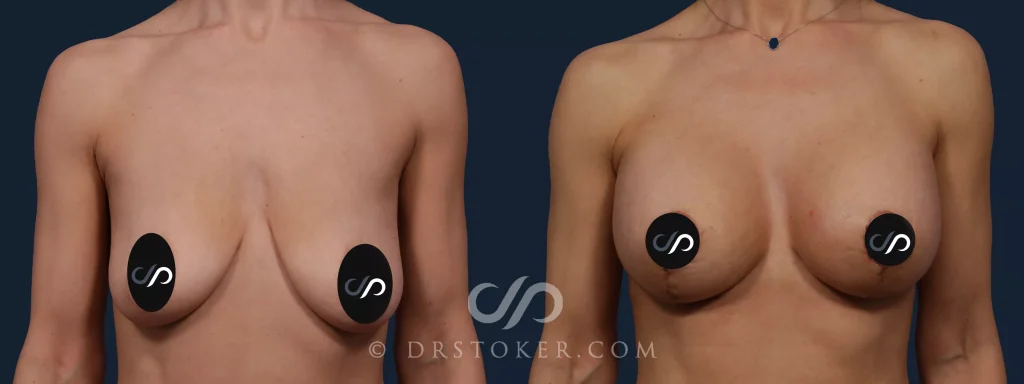
Breast tissue is made up of a mix of fat, glandular tissue, and the skin envelope that contains both. In adult women who are not currently breastfeeding, a large share of breast volume comes from fat — which means that when the body loses fat quickly, as it often does on a GLP-1 medication, the breasts can lose volume in a way that’s noticeable and, for many patients, disproportionate to the rest of their weight loss.
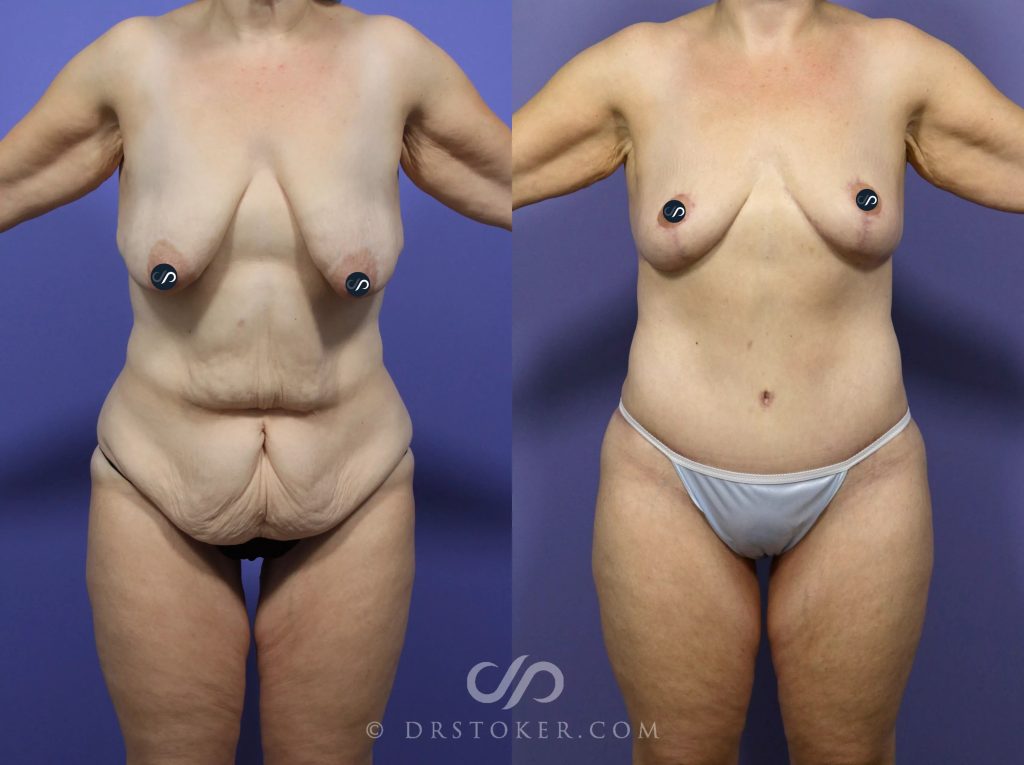
Volume loss is only part of the story. The skin and connective tissue that support the breast stretch to accommodate their previous size, and when that support isn’t asked to hold as much volume, it doesn’t always retract on its own — particularly with rapid weight loss, where there’s less time for gradual adaptation. That combination of reduced volume and skin that hasn’t fully retracted is what produces the look patients describe: breasts that appear flatter, lower, or less full than they did before, even at a lower, healthier body weight.
It’s worth saying plainly that GLP-1 medications aren’t unique in causing this. Dr. Stoker sees the same underlying pattern in patients after major weight loss from bariatric surgery, sustained diet and exercise, or significant weight changes tied to pregnancy, aging, or hormonal shifts. What’s different about the current wave of GLP-1 patients is how quickly the weight often comes off, and how many patients are experiencing this for the first time without ever having considered plastic surgery before. Genetics, skin quality, prior pregnancies, and age all play a role in how much a given patient’s breasts change — there isn’t one factor that explains it for everyone, and Dr. Stoker evaluates that mix individually with each patient rather than assuming GLP-1 use alone tells the whole story.
The Two Separate Problems: Volume and Position
One of the most useful things Dr. Stoker can do in a consultation is help a patient separate two issues that often get lumped together: how much breast volume remains, and where the breast tissue is sitting on the chest wall. They don’t always move together, and the surgical answer is different depending on which one — or both — is the primary concern.
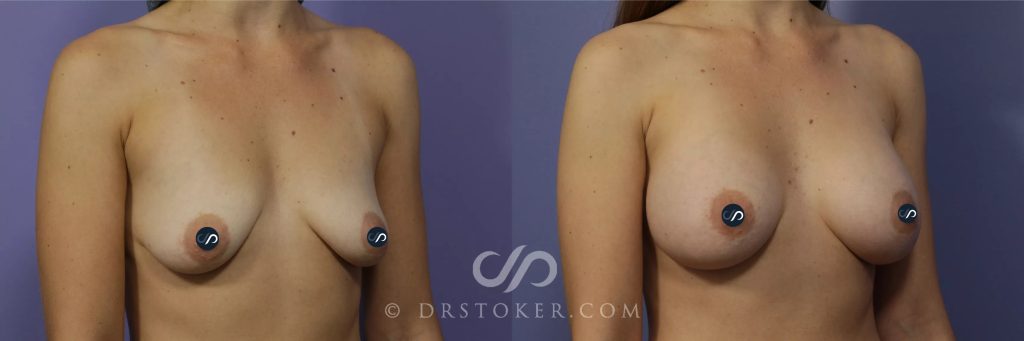
If the main issue is lost volume, with breasts that are still reasonably well-positioned, breast augmentation alone may be enough to restore fullness. If the main issue is position — breasts that have dropped, with the nipple sitting lower on the chest — a breast lift (mastopexy) addresses that by repositioning tissue and removing excess skin, independent of adding volume. Many GLP-1 patients have some degree of both, which is where a combined lift-and-augmentation approach comes in: restoring volume with an implant while also correcting position and skin excess in the same operation. Dr. Stoker discusses the tradeoffs of each of these three paths in more detail in Breast Augmentation After Weight Loss Surgery, which is worth reading alongside this article for patients trying to understand their own options.
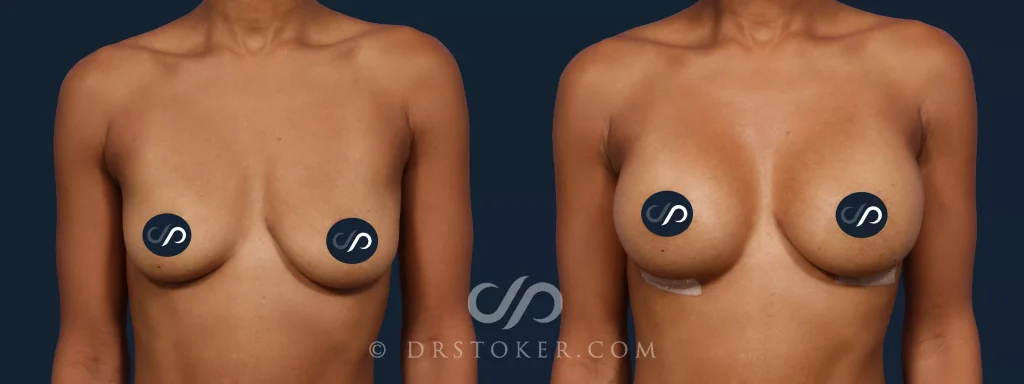
For patients who already have breast implants and are noticing that GLP-1-related weight loss has changed how those implants look or sit — more visible rippling, an implant that now looks too large or too small for the body it’s on — that’s a slightly different conversation, closer to a revision discussion. The breast implant revision FAQ is a useful starting point for patients in that situation.
When Surgery Isn’t the Right Answer Yet
Not every patient in this situation is a candidate for surgery, and not every patient wants to be. For patients who are still actively losing weight, Dr. Stoker typically recommends waiting until weight has been stable for a meaningful period of time before pursuing a surgical solution — operating on a moving target makes it harder to plan for a result that will hold up over time. The right amount of time varies by patient, which is exactly why this is a conversation to have in consultation rather than a rule to apply generally.
For patients who are in that waiting period, or whose volume and skin changes are more modest, nonsurgical options that support skin quality can be a reasonable interim step — though they won’t reverse significant volume loss or true sagging the way surgery can. Carla Crespo, MSHS, PA; Brittany Lehmann, PA-C; and Stacy Wright, RN — Stoker Aesthetics’ team of aesthetic specialists — regularly work with patients in this exact situation to support skin quality with treatments like Morpheus8 and Sculptra while a surgical decision is still on the horizon, or as a standalone approach for patients who aren’t ready for surgery.
Dr. Stoker’s Approach to Breast Restoration Surgery for These Patients
When a patient comes in with breast changes from significant weight loss, Dr. Stoker’s goal isn’t to talk everyone into the biggest possible procedure — it’s to match the operation to what’s actually changed. For patients who need volume restored, he offers both silicone gel and saline implants, and for the substantial majority of patients, cohesive silicone gel implants are the better match because they look and feel closer to natural breast tissue. Implant size and profile are chosen based on the patient’s goals and remaining tissue, not a standard formula, and for patients who’ve become more physically active since losing weight — running, lifting, hiking — that lifestyle shift is part of how Dr. Stoker thinks through sizing with them.
For patients whose primary need is augmentation alone, Dr. Stoker uses his Rapid Recovery Breast Augmentation protocol whenever appropriate — a combination of gentle tissue-handling technique, precise pocket dissection, touch-free implant placement with a Keller Funnel®, and long-acting local anesthesia that together are designed to reduce trauma and get patients back to non-strenuous activity within days rather than weeks. Patients can read more about what that actually looks like day to day in How Rapid Is Rapid Recovery Breast Augmentation?. When a lift is needed — alone or combined with an implant — recovery is naturally somewhat longer, since more tissue is being repositioned, and Dr. Stoker walks through that timeline individually with each patient rather than promising a single universal number.
This is also territory Dr. Stoker knows from a different angle than most surgeons currently writing about GLP-1 and the body: he has spent a large part of his career caring for patients after massive weight loss, including through his work connected to Extreme Makeover: Weight Loss Edition, well before “Ozempic breasts” was a phrase anyone used. The tissue changes are physiologically similar whether the weight came off over eighteen months after bariatric surgery or over a shorter window on a GLP-1 medication — which means the surgical judgment involved in restoring the chest is judgment Dr. Stoker has been applying for a long time, not something he’s learning alongside this new wave of patients.
Patients who’ve also noticed changes to their face or lower body since starting a GLP-1 medication may find it useful to read Facelift After Weight Loss: Tackling “Ozempic Face” and Say Goodbye to Ozempic Butt With a Bikini Body Lift™ — many patients are dealing with more than one of these changes at once, and Dr. Stoker plans surgical timing around the whole picture rather than one area at a time.
Common Questions
Is “Ozempic breasts” a medical diagnosis?
No — it’s become a popular shorthand for a real, physically understandable pattern (fat and volume loss combined with skin that hasn’t fully retracted), not a distinct medical condition. The underlying tissue changes are ones plastic surgeons have treated in post-weight-loss patients for a long time.
Will breasts go back to normal after stopping the medication?
Not typically, and Dr. Stoker doesn’t counsel patients to expect that. Once fat volume has been lost from the breast and the skin envelope has stretched to accommodate a larger size, that combination generally doesn’t reverse on its own, regardless of what happens with future weight changes.
Does a patient need a lift, an augmentation, or both?
That depends on whether the main concern is volume, position, or both — which is exactly what a consultation is for. Dr. Stoker evaluates each patient’s anatomy individually rather than assuming one answer fits every GLP-1 patient.
Is it safe to have breast surgery while still taking a GLP-1 medication?
This is a question to discuss directly with both the prescribing physician and the surgeon, since it depends on the patient’s individual health status and where they are in their weight-loss process. It isn’t something Dr. Stoker generalizes into a blanket rule.
A Next Step, Not a Sales Pitch
For patients whose breasts have changed since starting a GLP-1 medication and who aren’t sure whether that change is something they want to address — or how — the most useful next step is usually a straightforward consultation, not a decision made from a mirror or a search engine. Dr. Stoker examines each patient’s anatomy, asks about weight history and goals, and walks through which of these options, if any, actually fits the patient’s situation.
Dr. David Stoker is a board-certified plastic surgeon in Los Angeles with more than 25 years of experience, including extensive work with patients following significant weight loss.
Leave a Reply